 Langrit
Why your AI tutor forgets your mistakes, and how to fix it
ChatGPT and Claude remember things about you now, but not the Dutch mistakes you made last week. What built-in memory keeps, and two ways to fix it.
You practise Dutch with ChatGPT on Monday. It catches that you write het tafel and that you leave the verb in the middle after omdat. On Thursday you open a new chat and make both mistakes again. The tutor corrects them as if it had never seen them.
It still knows who you are. It knows you are learning Dutch, and probably that you like short answers. The list of what went wrong on Monday is the part that did not make it to Thursday.
What built-in memory keeps
Both apps have a memory now. ChatGPT can use saved memories and your past chats, and OpenAI's help page says where that stops: "Memory does not retain every detail from every conversation." ChatGPT picks what it thinks is relevant. Claude writes a summary of your conversations and refreshes it every 24 hours, and on paid plans it can search your past chats when you ask it to (Anthropic's help page).
Both were built so you can pick up a project where you left it. A summary has room for "is learning Dutch, level A2, finds word order hard". A learner needs something more exact than that.
What a learning memory needs
A tutor who helps you over months keeps track of three things:
- What you got wrong, in your own words, with the correct form next to it.
- When you last saw it, and whether you got it right that time.
- What is due: the mistakes that are about to slip back and need one more round today.
The third one is spaced repetition. You review a mistake shortly before you would forget it, then again after a longer gap. It is one of the best-tested ideas in learning research, and it only works with a record kept over time. Chat memory was not built to keep that record, and nothing in it decides on Thursday that Monday's mistake is due.
Option 1: keep the list yourself
Keep a note called "My Dutch mistakes". At the end of each session, ask:
List every mistake I made in this chat as: what I wrote → the correct form → the rule in one line. No other text.
Paste the result into your note. At the start of the next chat, paste the note back with:
These are my recent Dutch mistakes. While we practise, make me use these forms again, and tell me when I repeat one.
It works. It also depends on you doing it every single time, and after a month the note is too long to paste.
Option 2: connect a memory
Langrit is a memory for AI tutors, and it is free. You connect it once (ChatGPT, Claude, about two minutes). From then on the tutor saves each mistake as a review card when it corrects you. In any later chat you can ask:
Use Langrit. What do I keep getting wrong, and what is due for review today? Quiz me on the due ones, one at a time.
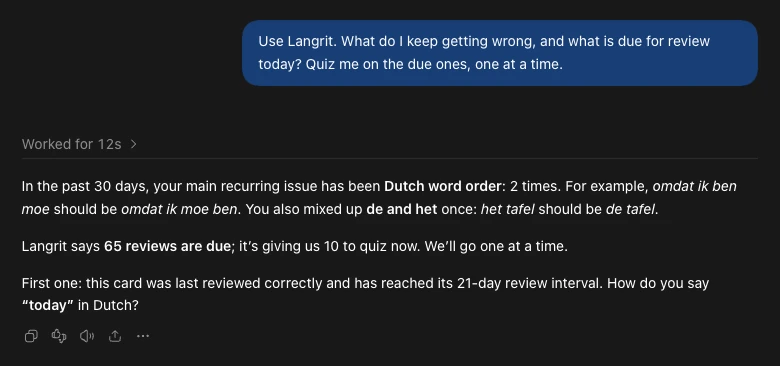
This was a new chat. The tutor knew that word order went wrong twice in the past 30 days, with the omdat sentence as the example, and that het tafel should be de tafel. It also knew how many reviews were due and started with a card that had reached its 21-day interval.
The list lives in your Langrit account, so it is the same list in every chat and in both apps. Each answer you give moves the card: get it right and it comes back later, get it wrong and it comes back sooner.
See how the AI-tutor memory works. Your mistakes stay yours, and you can export them at any time.