 Langrit
Is Duolingo enough to learn Dutch? What to add after it
Duolingo is a good first step in Dutch. Where the course ends, what you still need after it, and a Duolingo alternative or add-on for each gap.
Many people who start Dutch start with Duolingo, and that is a sensible choice. It is free, it is on your phone, and it gets you from zero to reading simple sentences without any planning. The question comes a few months in, when you have a long streak and still freeze at the bakery.
What Duolingo does well
- It gets you started. There is no material to find and no plan to make. You open the app and the next lesson is there.
- It builds a daily habit. The streak, the reminders and the short lessons make it easy to do something every day. For a beginner, showing up daily matters more than the method.
- It teaches a first vocabulary. The Dutch course has 123 units (unofficial course data), enough for the common words and the basic sentence patterns.
Where the course ends
The same course data puts the end of the Dutch course at about A2. If you live in the Netherlands, A2 is where real life starts asking more: a letter from the gemeente, a phone call with the GP, small talk with colleagues.
Three things are outside what the course is built for:
- Your own sentences. Every learner gets the same sentences. Nobody gets "I work in a hospital in Utrecht" or "my daughter's school called".
- Writing more than one line. The exercises are single sentences: translate one, pick the missing word, repeat one aloud. There is no place to write five sentences about your day and get them corrected. The AI conversation features, Roleplay and Video Call, are listed for French, Spanish, German, Italian and Portuguese, and Dutch is not on that list.
- Your mistakes as patterns. The Practice tab has a Mistakes list where you redo the exercises you got wrong. That helps with those exact sentences. It does not tell you that word order after omdat is the thing you keep missing, and it cannot see the mistakes you make outside the app, in a message to a colleague or a chat with an AI tutor.
A streak has the same blind spot. Duolingo counts a day when you complete one lesson. That is good for the habit, and it tells you little about what you can say.
What to add, gap by gap
| Gap | What fills it | Free option |
|---|---|---|
| Grammar explained, with the rule | A grammar lesson per topic | Dutch grammar lessons, A1 to B2 |
| de or het | A rule list and a checker | de or het tool |
| Verb forms | Full tables with past tense | Dutch verb tables |
| Your own sentences corrected | An AI tutor with the right prompt | Corrections without a rewrite |
| Your mistakes coming back | A memory that schedules them | Langrit memory for ChatGPT and Claude |
| Knowing your level | A placement test | Dutch level test |
Duolingo and Langrit side by side
| Duolingo | Langrit | |
|---|---|---|
| What you study | A fixed course, the same for everyone | Sentences about your own life, plus the mistakes you make |
| A daily session | Short lessons along the path | Five steps: read, notice, write, review, fix |
| Writing | Single sentences | A short text every day, corrected, with the mistakes saved |
| What comes back tomorrow | The next lesson, plus a list of missed exercises to replay | Your mistakes grouped by pattern, and the words you are about to forget |
| Daily goal | One lesson keeps the streak | Minutes of real study |
| Price | Free with ads, paid plan without | Free memory for your AI tutor; the app has a 14-day trial, then €6.99 a month |
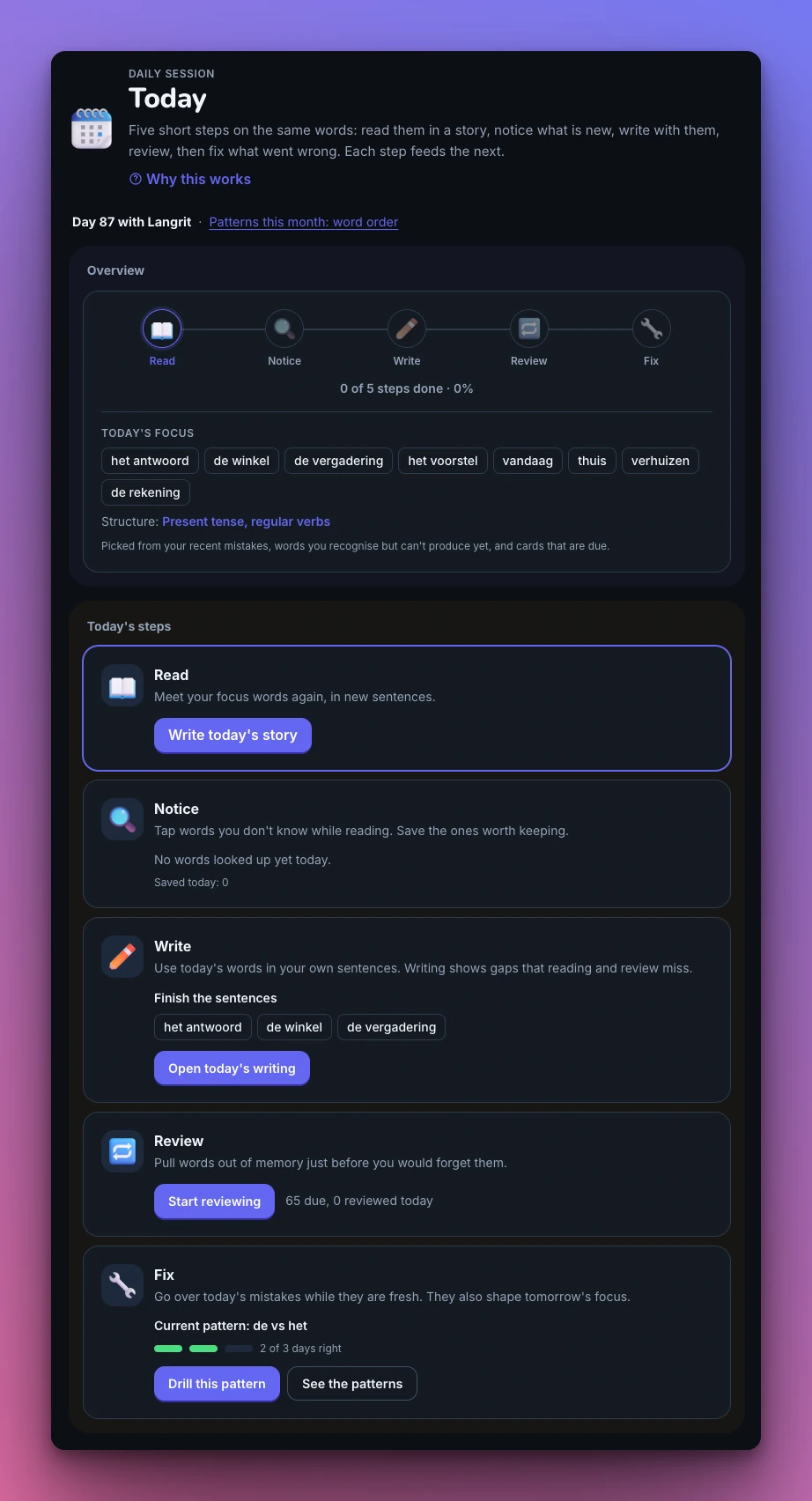
In this session the eight focus words come from recent mistakes and from cards that are due. You read them in a story, write with three of them, review the 65 cards that are due, and end on the pattern that keeps going wrong, here de or het, at 2 of 3 days right.
Which one, when
In your first weeks, Duolingo alone is fine. Keep the streak; it is doing its job.
Once you can read simple sentences, add ten minutes a day of work on your own material: write a few sentences about your day, get them corrected, and review what went wrong. You can do that with ChatGPT and a note, or with Langrit, which keeps the record for you. Many learners keep Duolingo next to it for the habit.
If you have an exam or a job that needs Dutch, move most of your time to writing, speaking and your own mistakes. That is where the exam and the job are.
Try Langrit free for 14 days, no card needed.